


Online fraud rarely arrives with a clear warning.
A suspicious order might have a billing and shipping mismatch. A buyer might try several cards before completing a purchase. A merchant may encounter first-party misuse or refund and policy abuse after the sale. Other buyers may attempt to exploit promotions, accounts or store policies.
A Shopify fraud filter can help identify or block some of this activity. But “fraud filter” can mean several different things today.
Shopify’s former Fraud Filter app is no longer available. In its place, merchants now have several layers of fraud prevention: Shopify’s built-in fraud analysis, Fraud Control checkout rules, Shopify Flow and third-party fraud apps.
Those tools do not all work the same way.
Fraud Control applies merchant-defined rules. Shopify Flow automates actions. And Shopify’s own fraud recommendations are powered by machine-learning algorithms.
That distinction matters as merchants face a broader mix of payment fraud and customer abuse. The 2026 Global eCommerce Payments & Fraud Report, based on responses from 1,278 merchant professionals across 37 countries, found that respondents reported losing an average of 3.2% of annual ecommerce revenue to payment fraud globally. It also found that 62% reported an increase in first-party misuse disputes, while 57% reported an increase in refund or policy abuse.
This guide explains how Shopify’s current fraud tools work, where merchant-defined rules are useful, where they have limitations and how contextual fraud detection can add another layer of information before an order is fulfilled.
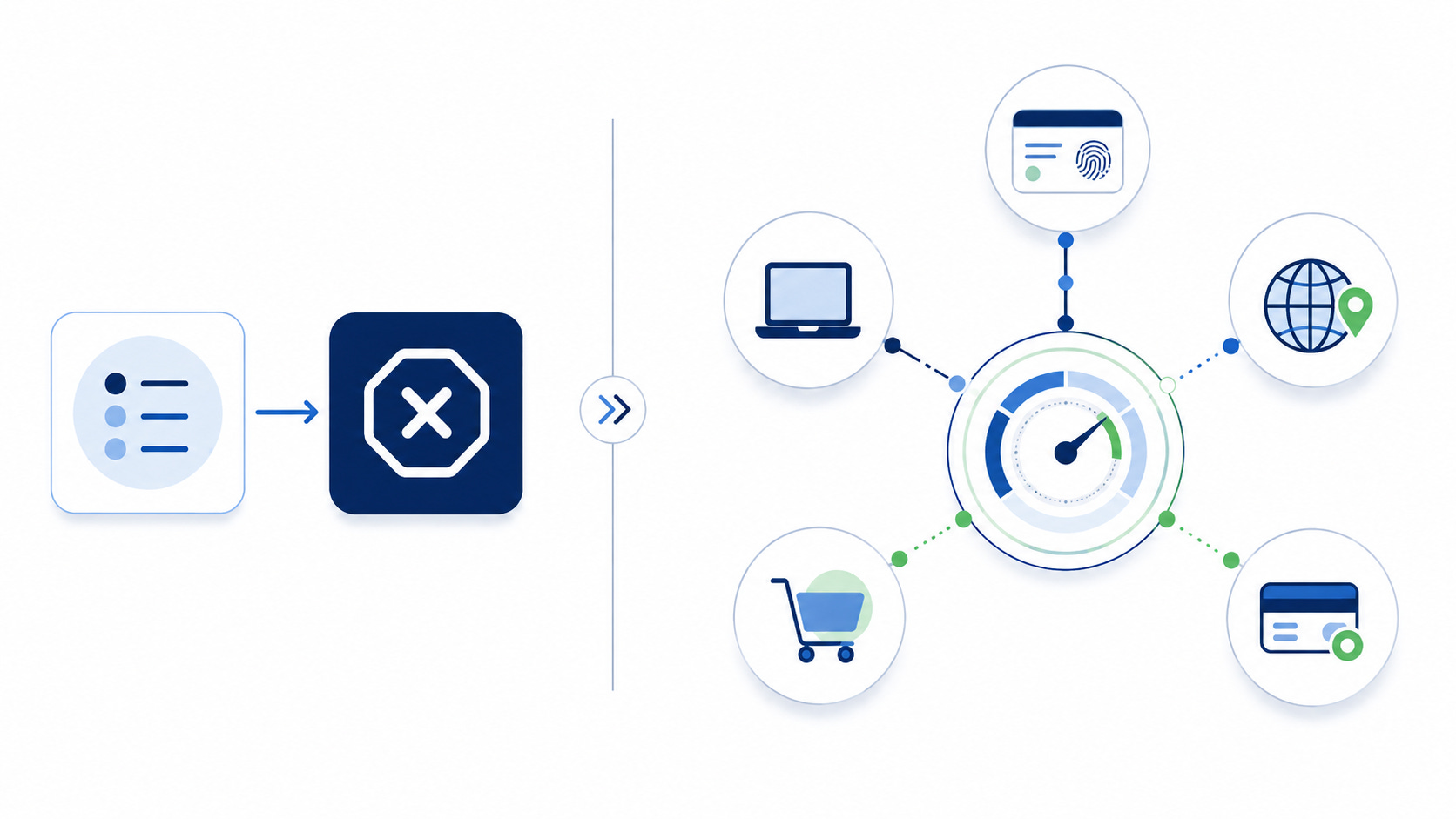
What is a Shopify fraud filter?
Today, “Shopify fraud filter” is best understood as a broad description rather than the name of one current Shopify product.
It can describe tools that help merchants:
Block a known email address or IP address
Reject checkouts that match specific conditions
Flag unusual payment activity
Hold high-risk orders before fulfillment
Automate actions based on fraud risk
Analyze identity, behavior, location and transaction information
Some controls operate during checkout and can prevent a checkout from becoming an order.
Others analyze an order after checkout and provide information that helps a merchant decide whether to fulfill, review, hold or cancel it.
That difference is important.
A rule that blocks a known IP address solves a different problem from a fraud system that evaluates the overall risk of an order using multiple pieces of context.
What happened to Shopify’s original Fraud Filter app?
Shopify’s former Fraud Filter app is no longer available in the Shopify App Store.
If you encounter older articles referring to it, Shopify’s former Fraud Filter Help Center URL now redirects to its guidance for managing high-risk orders with Shopify Flow.
There is not one direct replacement.
Today, Shopify merchants can use a combination of:
Shopify Fraud Analysis
Fraud Control
Shopify Flow
Manual payment and fulfillment controls
Third-party fraud prevention apps
Each serves a different purpose.
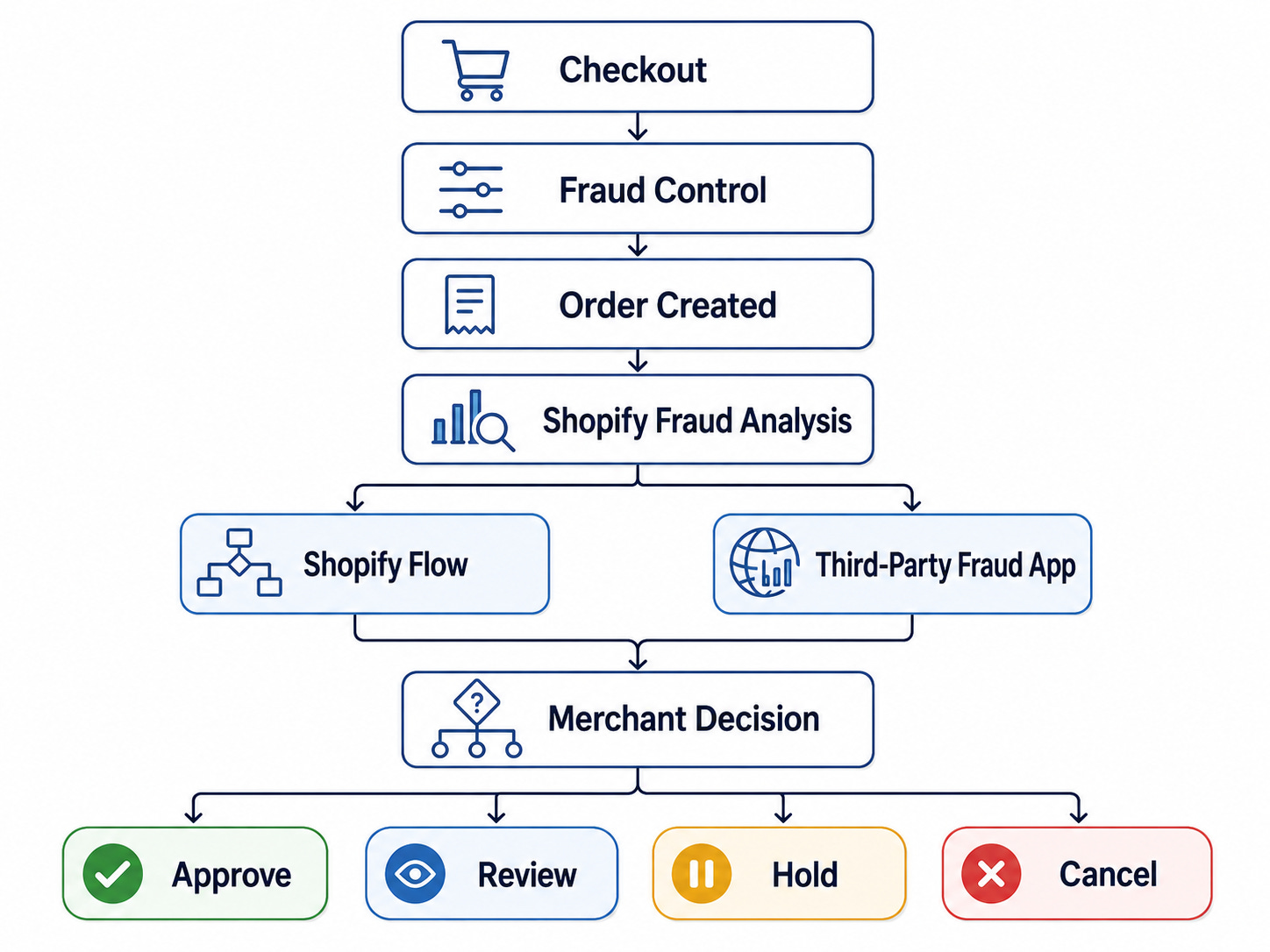
Shopify’s built-in fraud analysis
Shopify’s built-in fraud analysis is designed to evaluate eligible online credit-card orders when Shopify can verify the payment.
The analysis provides fraud indicators that merchants can use when investigating an order.
Depending on the transaction, those indicators can include:
Address Verification System, or AVS, results
Whether the correct card security code was provided
Information about the IP address used to place the order
Whether the customer attempted to use more than one credit card
Where fraud recommendations are available, Shopify can classify an order as having a low, medium or high risk of a chargeback due to fraud.
There is an important eligibility detail. Shopify states that stores on Grow or higher, or stores using Shopify Payments on any plan, can receive Shopify fraud recommendations. Basic stores that do not use Shopify Payments receive fraud indicators and support for third-party fraud apps, but not Shopify’s fraud recommendations.
And Shopify’s fraud recommendations are not simply a collection of static rules.
Shopify says its recommendations are powered by machine-learning algorithms trained on historical transactions across Shopify stores, and that those algorithms are continuously improved.
That means the useful comparison is not “Shopify versus AI.”
Shopify already uses machine learning.
The more useful distinction is between merchant-defined rules, workflow automation, and contextual or model-based fraud detection.
Shopify advises merchants to review high-risk orders before fulfillment because fulfilling them can increase chargeback exposure and, in serious cases, affect payment processing.
A high-risk recommendation also does not automatically require cancellation. Depending on the circumstances, a merchant might verify the order, hold it, cancel it or refund it.
Shopify Fraud Control
Fraud Control is Shopify’s fraud analytics and checkout-rules app.
Its dashboard provides fraud-related metrics, while its checkout rules let merchants create controls using information such as:
Email addresses
IP addresses
Address attributes
Combinations of checkout conditions
There is an important restriction: Fraud Control checkout rules are only available to merchants using Shopify Payments.
Unlike Shopify’s machine-learning fraud recommendation, Fraud Control checkout rules act on conditions defined by the merchant.
For example, a merchant can create a rule around a known IP address or combine multiple checkout conditions. If a checkout matches a blocking rule, Fraud Control can prevent it from becoming an order.
That makes rules useful for known and repeatable activity.
But Shopify also warns merchants to configure Fraud Control carefully because broad rules can prevent legitimate customers from checking out. Shopify also makes clear that checkout rules do not guarantee that chargebacks will not occur.
Shopify Flow
Shopify Flow is an automation platform.
It allows merchants to build workflows using triggers, conditions and actions.
For fraud-related use cases, Shopify documents workflows that can:
Capture payment when an order is not high risk
Cancel and restock a high-risk order
Send an internal notification
React to known bad email addresses
Take action on customers with frequent return activity
Flow can reduce repetitive manual work and help merchants apply a consistent response.
But Flow and fraud detection are not the same thing.
Flow acts on the triggers, conditions and risk information available to the workflow. In other words, it can automate the response to a risk signal without necessarily being the system that generated that signal.
How rules-based fraud filters work
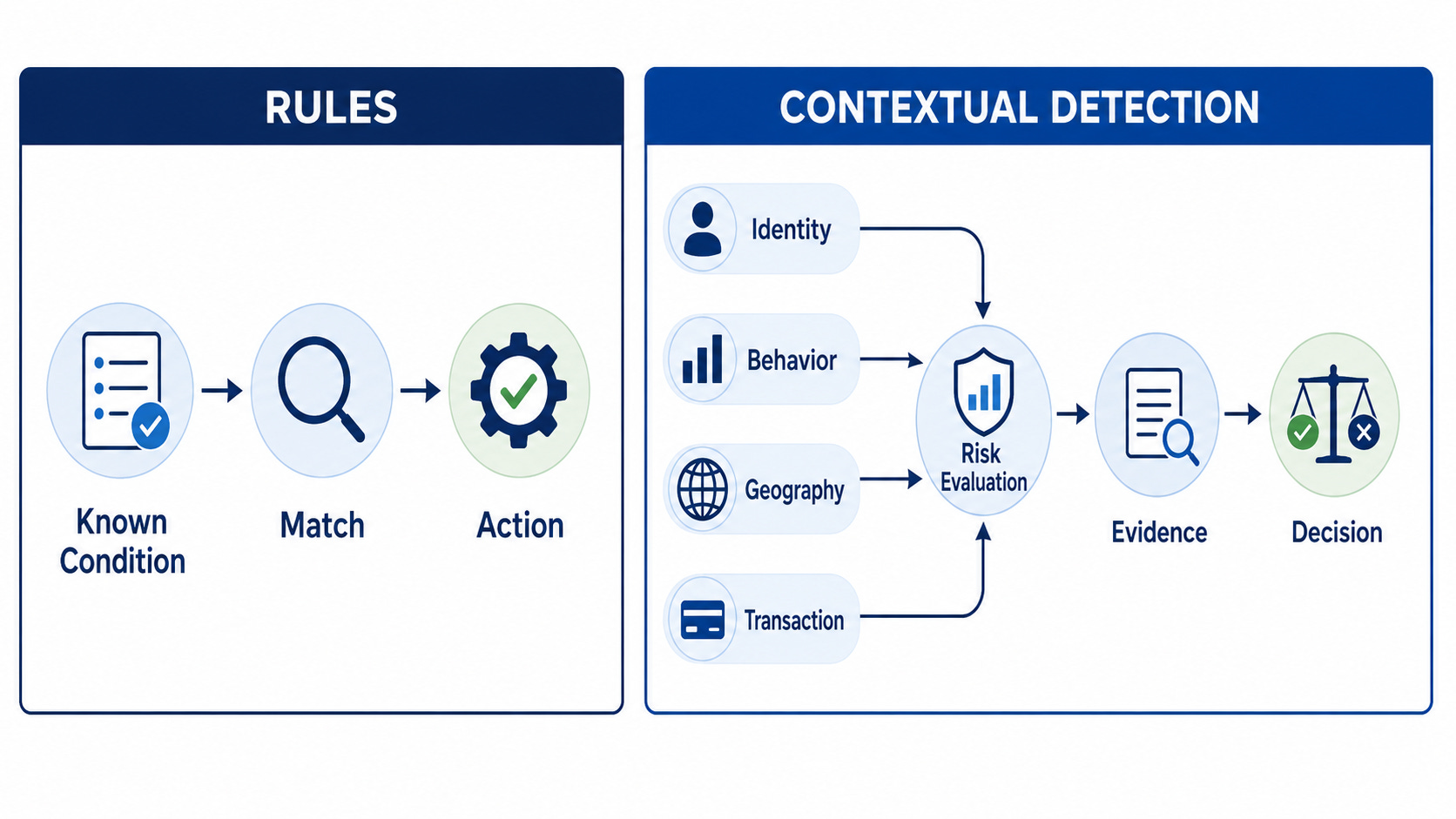
A rules-based fraud filter follows a simple model:
If a defined condition occurs, take a defined action.
A merchant could create logic such as:
If an email address matches a confirmed blocklist, block the checkout.
If a known abusive customer attempts another purchase, send the order for review.
If specific checkout conditions occur together, hold the order.
If a customer meets a defined return-abuse threshold, trigger a workflow.
Rules are valuable because they are predictable.
The merchant knows what condition was matched and what action should follow.
They work especially well for known situations such as:
Confirmed fraudulent email addresses
Known abusive customers
Specific IP addresses
Restricted destinations
Store-specific purchasing restrictions
Previously identified fraud patterns
But fraud does not always repeat in exactly the same form.
Where static fraud filters fall short
A rule can only respond to the conditions it was designed to recognize.
If a merchant blocks one fraudulent email address, the buyer can use another. IP addresses can change, and Shopify itself advises merchants to consider the possibility of proxy-service IP addresses.
At the same time, a rule that is too broad can create a different problem: blocking legitimate customers.
The financial tradeoff is significant.
The 2026 LexisNexis True Cost of Fraud Study found that U.S. merchants incur approximately $5.13 in total cost for every $1 of direct fraud loss. The study also reported that 54% of U.S. ecommerce merchants experienced increased customer churn linked to anti-fraud measures.
The objective, then, is not simply to block more transactions.
It is to stop meaningful risk while minimizing unnecessary friction for legitimate buyers.
1. Fraudsters can change individual details
Emails, devices, IP addresses and other transaction information can change from one attempt to another.
Blocking a single identifier can stop one attempt without necessarily identifying a broader pattern.
2. A single signal can be misleading
A billing and shipping mismatch might indicate elevated risk.
It might also be a gift.
A high-value order can be unusual without being fraudulent. An international IP address might warrant additional review without independently proving anything about the buyer.
The better question is not simply:
Is one part of this order unusual?
It is:
What does the combination of available information tell us about the risk of this order?
3. Rules need periodic review
Merchant-defined rules should be revisited as fraud patterns, customer behavior and store policies change.
Otherwise, rules can become outdated, overlap with one another or continue blocking activity that no longer represents the same level of risk.
4. Broad rules can reject good customers
A rule is deterministic.
If the condition matches, the action happens.
That is useful when the condition is highly reliable. It becomes more problematic when the signal has multiple legitimate explanations.
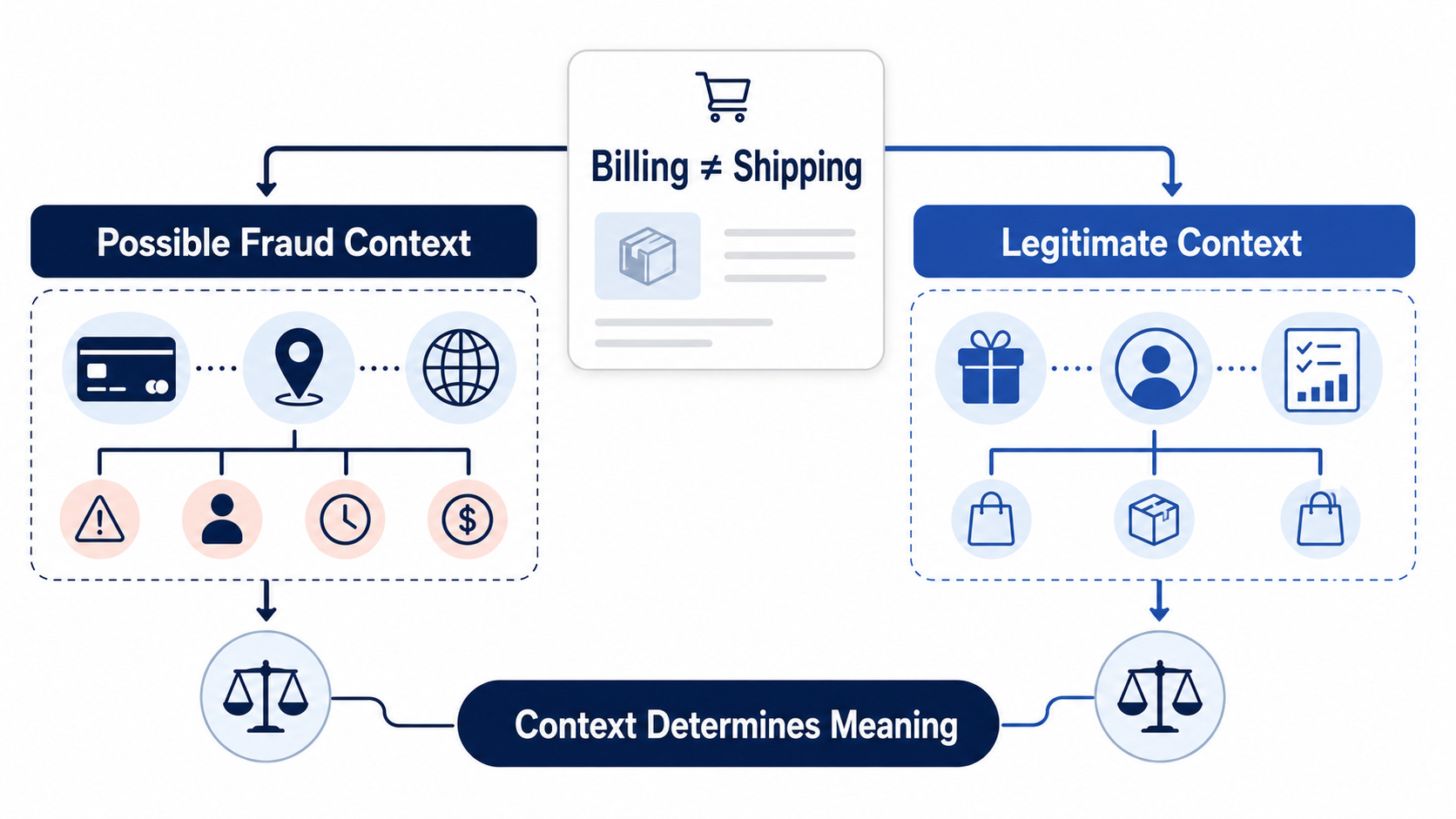
How contextual AI fraud detection is different
Machine-learning and AI-based fraud systems can evaluate patterns across multiple signals instead of relying entirely on a single merchant-defined condition.
The exact information analyzed varies by product.
Depending on the system, relevant signals can include categories such as:
Buyer identity
Device or network context
Geographic information
Purchasing behavior
Transaction information
Historical activity
Relationships between pieces of transaction data
Consider an order with different billing and shipping addresses.
A static rule could be configured to block the order immediately.
A contextual fraud system can potentially evaluate additional questions:
Is the buyer information internally consistent?
Are other transaction signals unusual?
Has the buyer attempted multiple payment cards?
Does the location information make sense?
Is the behavior consistent with legitimate transactions?
Are several otherwise small risk indicators appearing together?
The objective is not to assume every unusual transaction is fraudulent.
It is to determine whether unusual activity is supported by enough additional context to represent meaningful risk.
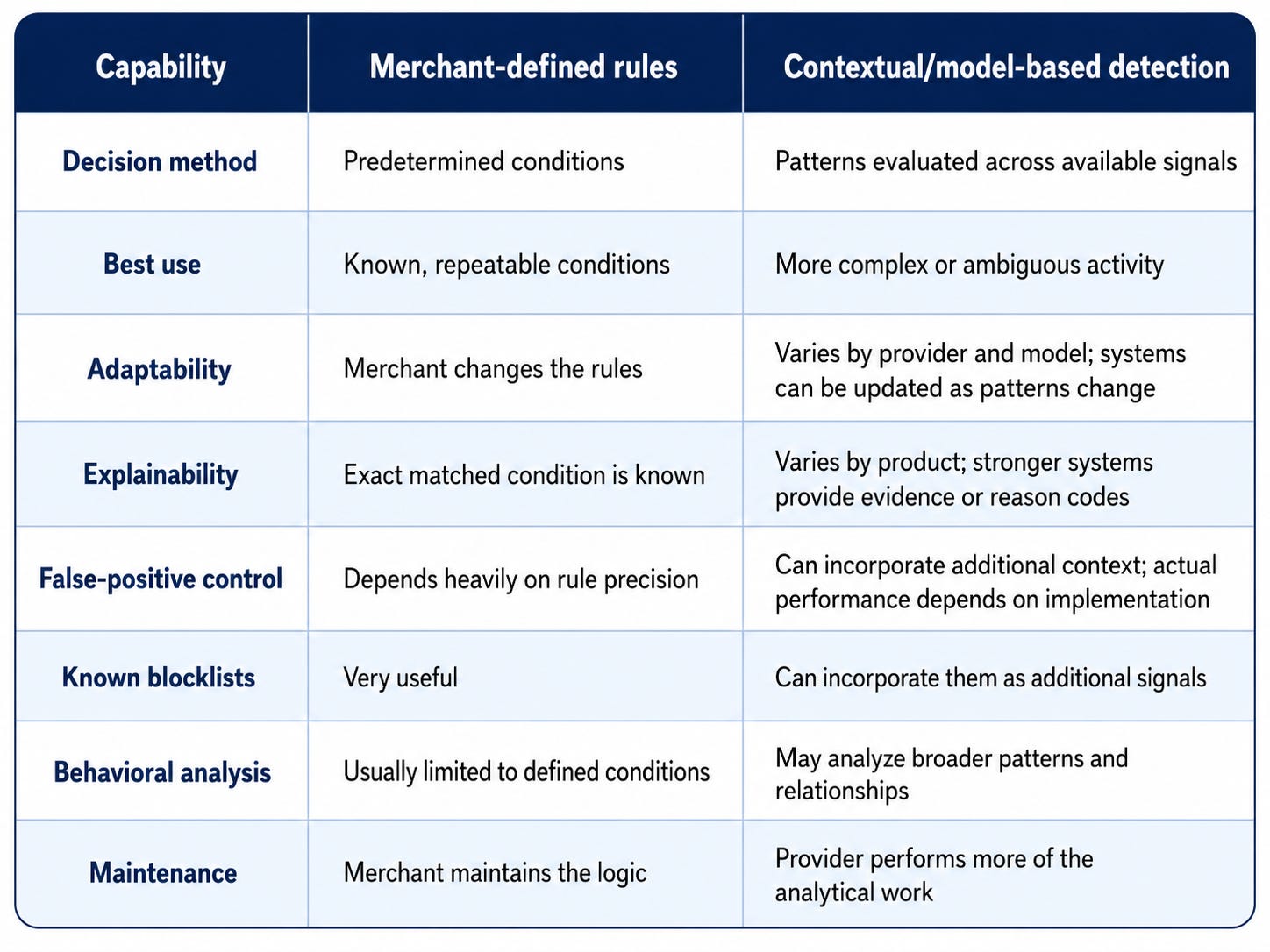
Rules-based filters vs. contextual fraud detection
Should every high-risk Shopify order be automatically canceled?
Not necessarily.
Shopify itself presents several possible responses to a high-risk order rather than instructing merchants to automatically cancel every one.
When evidence is conclusive, automatic action can make sense.
When the evidence is less certain, holding an order for review may be preferable to either fulfilling it immediately or automatically rejecting a legitimate customer.
This becomes increasingly important as dispute volume grows.
In a June 2026 update, Mastercard projected that global chargeback volume will grow 37% from 2025 to 2029, reaching approximately 359 million transactions annually. Mastercard also reports that its 2025 data showed fraudulent chargebacks accounting for about 45% of merchant chargeback volume globally.
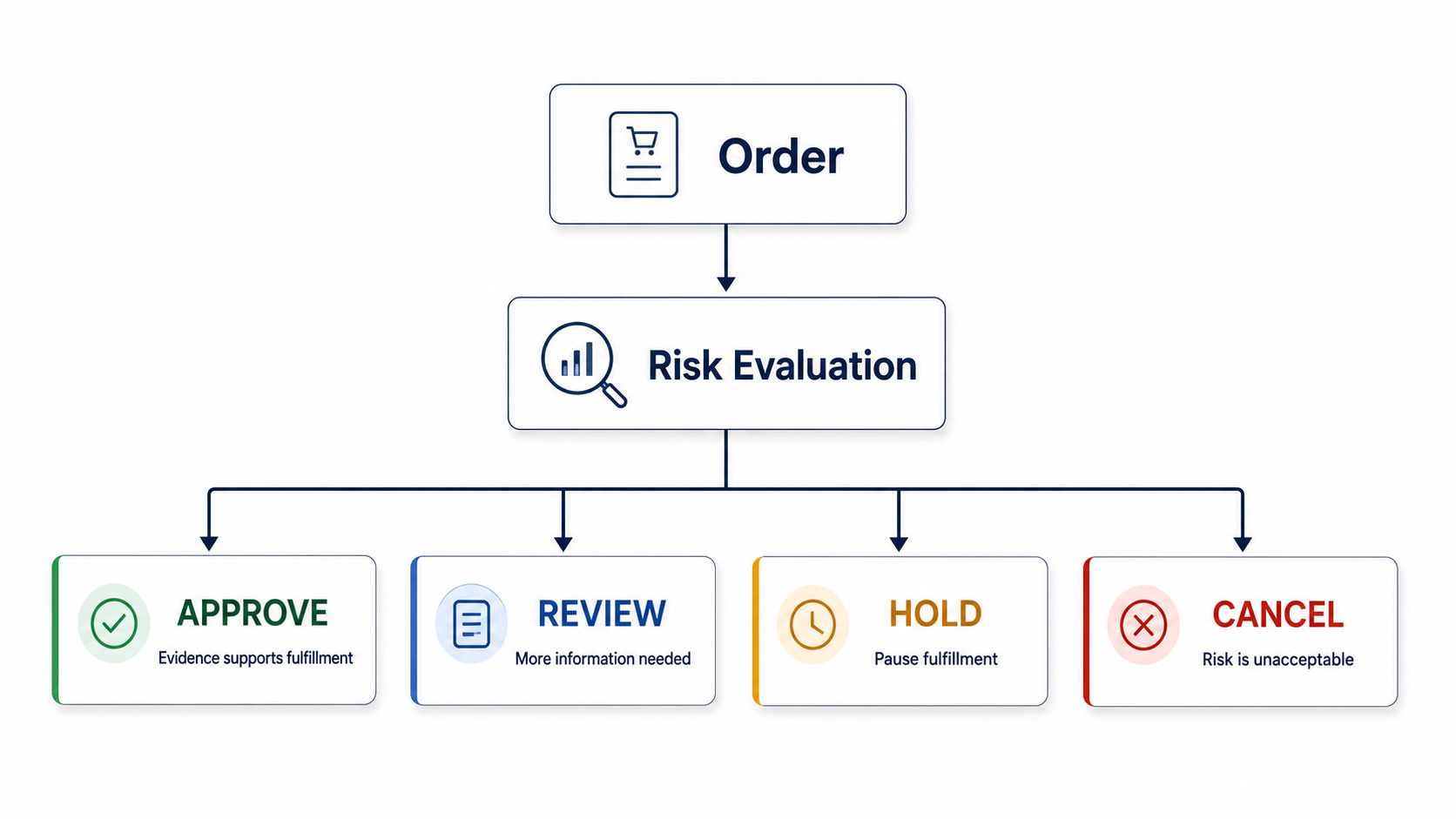
A practical risk workflow might include four outcomes:
Approve
The available evidence supports fulfilling the order.
Review
Something is unusual and the merchant needs additional information before deciding.
Hold
Fulfillment is temporarily paused while the order is investigated.
Cancel
The available evidence indicates that the fraud or abuse risk is unacceptable.
Merchants can also use manual payment capture to create additional review time before the payment is captured. The distinction matters because payment authorization can occur before capture.
A better Shopify fraud-filter strategy
1. Start with Shopify’s fraud information
Review Shopify’s recommendation where available, but also examine the individual indicators associated with the order.
A low, medium or high label is useful. The evidence behind it is useful too.
2. Use rules for known bad activity
Rules are well suited for highly specific conditions that you already understand.
Keep them targeted.
The broader the condition, the greater the chance that legitimate buyers will match it.
3. Evaluate multiple signals together
An address mismatch or unusual order value should not automatically determine the outcome.
Look at how the available information relates.
Risk is often more meaningful in combination than in isolation.
4. Make the decision before fulfillment
Shopify specifically recommends reviewing high-risk orders before fulfillment.
Once a disputed order has already been fulfilled, the merchant can face lost merchandise or service value in addition to dispute-related costs.
5. Track what happened
Record whether reviewed orders ultimately resulted in fulfillment, cancellation, refunds, disputes or confirmed abuse.
That gives merchants better information for deciding whether individual rules and review processes remain useful.
Going beyond a basic Shopify fraud filter
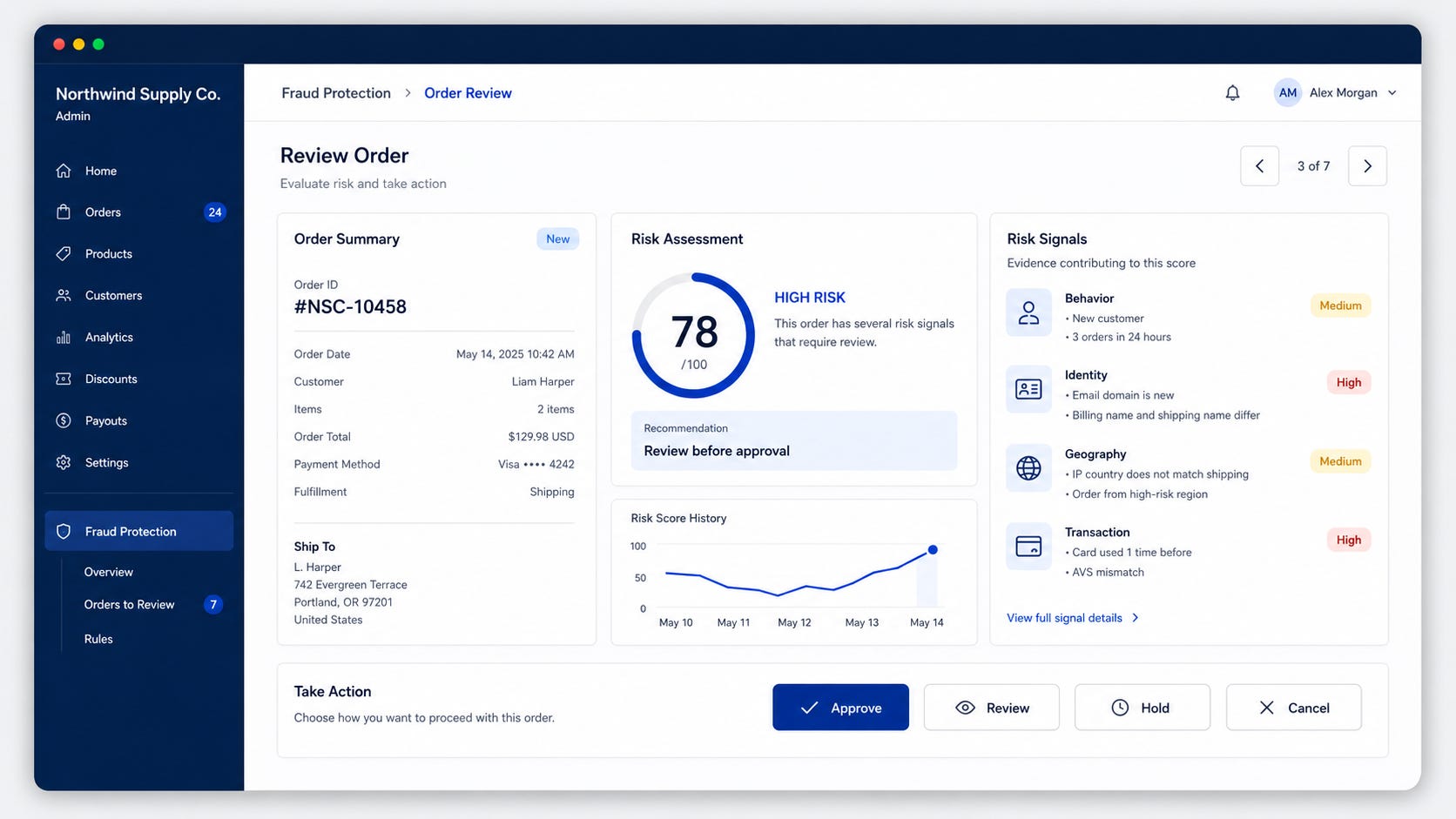
Alogram Payment Fraud Blocker is designed to help Shopify merchants evaluate risky orders before they ship.
Alogram analyzes behavioral, identity, geographic and transaction signals and presents order-level insights inside Shopify Admin.
The goal is to give merchants more context for deciding whether an order should be:
Approved
Reviewed
Held
Canceled
That additional context can also help merchants investigate activity that extends beyond traditional stolen-card fraud, including refund abuse, promotion abuse, reseller activity and suspicious buyer behavior.
This broader view matters because ecommerce risk increasingly continues beyond the original payment.
The National Retail Federation’s 2025 Retail Returns Landscape estimated that 19.3% of online sales would be returned in 2025 and found that 9% of all returns were fraudulent. It also reported that 45% of surveyed shoppers considered bending the rules when making a return acceptable.
Alogram is designed to help merchants add context to these decisions rather than automatically treating every unusual customer or transaction as fraud.
Final thoughts
Shopify merchants no longer have one product called Fraud Filter that represents the entire fraud-prevention stack.
Instead, Shopify provides several layers.
Fraud Control can apply merchant-defined checkout rules.
Shopify Fraud Analysis can provide indicators and machine-learning-based fraud recommendations for eligible orders.
Shopify Flow can automate actions.
And third-party fraud apps can add additional indicators, contextual analysis and actions.
Rules-based filtering answers a straightforward question:
Did this order match a condition we already defined?
Contextual fraud detection addresses a different question:
What does the available identity, behavior and transaction context tell us about the risk of this order?
For many Shopify merchants, the better strategy is not choosing one or the other.
It is using targeted rules for known problems, Shopify’s native fraud capabilities for the signals they provide and additional contextual analysis where the business needs a more complete view before fulfillment.
Frequently asked questions
Does Shopify still have a Fraud Filter app?
No. Shopify’s former Fraud Filter app is currently unavailable in the Shopify App Store.
Its former Help Center URL now redirects to Shopify’s guidance for managing high-risk orders with Shopify Flow.
What replaced Shopify Fraud Filter?
There is no single one-for-one replacement.
Relevant functionality is now distributed across Shopify Fraud Analysis, Fraud Control, Shopify Flow, manual payment and fulfillment controls, and third-party fraud apps.
Does Shopify use AI or machine learning for fraud detection?
Yes.
Shopify states that its fraud recommendations are powered by machine-learning algorithms trained on historical transactions across Shopify stores and that those algorithms are continuously improved.
That is separate from merchant-defined Fraud Control rules and Shopify Flow automation.
How does Shopify identify a high-risk order?
Shopify’s fraud analysis can consider indicators such as AVS results, CVV correctness, IP information and whether the buyer attempted to use more than one credit card.
For eligible merchants, Shopify can also provide a low, medium or high fraud-risk recommendation.
Should I automatically cancel every Shopify order marked high risk?
Not necessarily.
Shopify documents multiple possible responses to high-risk orders, including additional verification, cancellation and refunding. Merchants can also use fulfillment holds, Shopify Flow and manual payment capture to create additional review steps.
The appropriate action depends on the evidence available and the merchant’s risk tolerance.
Sources
Shopify, Managing high-risk orders with Shopify Flow
Shopify App Store, Fraud Filter
Merchant Risk Council, 2026 Global eCommerce Payments & Fraud Report
LexisNexis Risk Solutions, 2026 True Cost of Fraud
Mastercard, updated global chargeback outlook
National Retail Federation, 2025 Retail Returns Landscape
Shopify App Store, Alogram Payment Fraud Blocker
The Fraud Brief explores fraud, payments, identity and risk in a world increasingly shaped by AI.
Written by d’Artagnan Osborne, Founder of Alogram, where we’re building real-time fraud and payment risk decisioning for modern commerce. Learn more about Alogram for Shopify.