


Fraud did not just become more complex. It became faster.
Many attacks are not fundamentally new.
What has changed is how quickly attackers can repeat them, alter one data point, observe the result, and try again.
A different email. A new device. A slightly modified address. Another card. Another identity.
Each transaction may look unrelated on its own. Together, they reveal an attacker rapidly testing the boundaries of the fraud system.
Fast scoring is not fast learning!
Commercial fraud platforms often describe themselves as real time because they can return a risk score in milliseconds.
But the model behind that score may still take days or weeks to learn from a new attack.
It may depend on confirmed fraud outcomes, chargebacks, analyst investigations, new rules, retraining, validation, and deployment.
Those controls exist for good reasons. Fraud models should not rewrite themselves after every suspicious event.
But the mismatch is becoming difficult to ignore:
The AI attacker can adapt after every attempt. The defensive AI model often cannot.
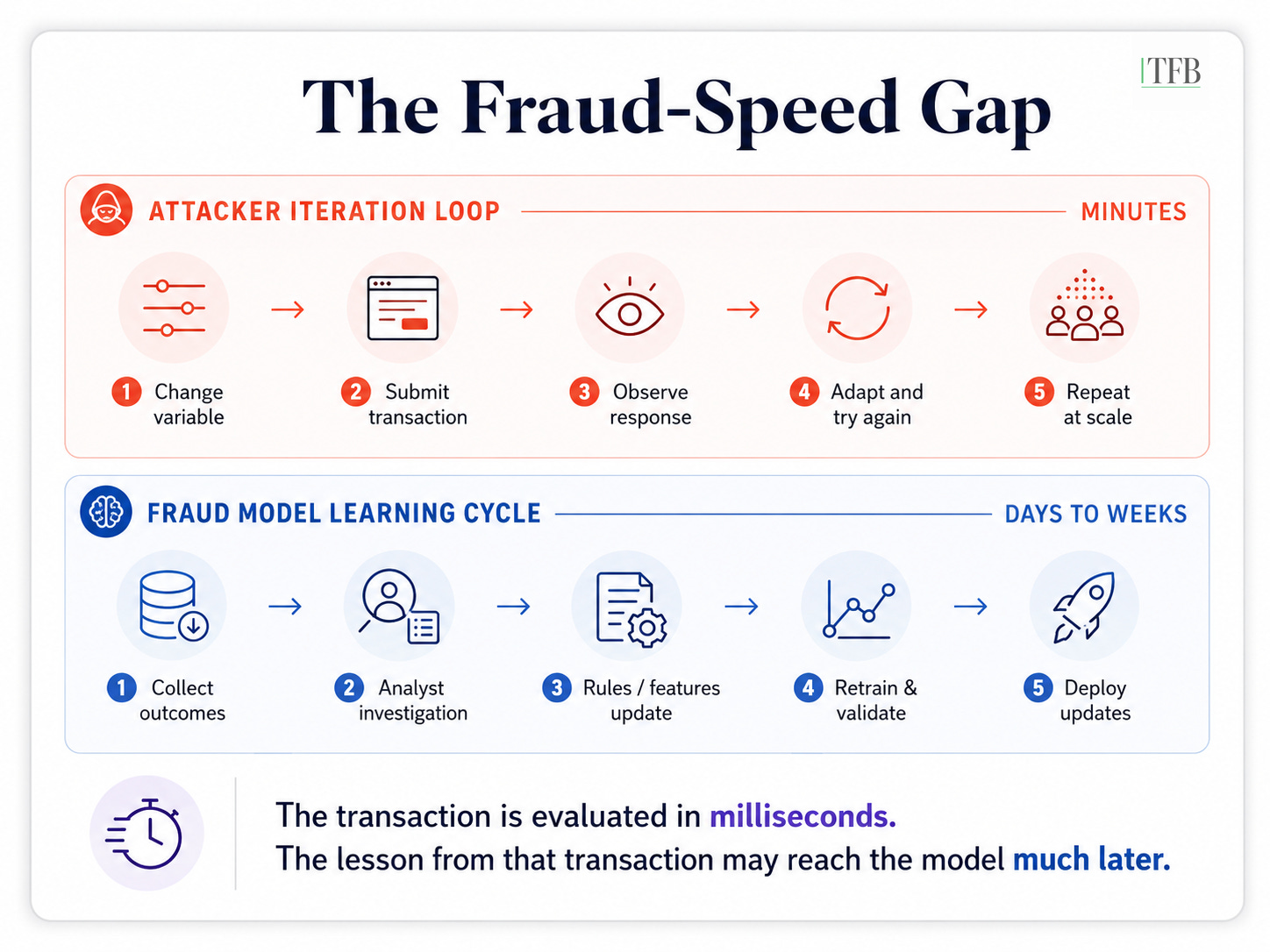
The real fraud-speed gap
Attackers are increasingly operating a rapid optimization loop:
Change one variable
Submit another transaction
Observe the response
Repeat until something works
Meanwhile, many fraud models are still learning from yesterday’s confirmed outcomes.
The transaction is evaluated in milliseconds. The lesson from that transaction may reach the model much later.
That delay is the fraud-speed gap.
AI must help train the fraud AI
The answer is not uncontrolled autonomous retraining.
The answer is using AI to compress the path between a new attack being observed and the defense being safely updated.
AI should help connect related attempts, identify which variables are changing, recognize emerging patterns, propose new signals, and test improvements before controlled deployment.
The goal is simple:
Keep human oversight and model governance, but move the learning loop much closer to the speed of the attack.
Learning speed is the next advantage
Fraud systems should be measured across two dimensions:
Decision speed: How quickly can the system score the current transaction?
Learning speed: How quickly can it understand a new attack and improve the next decision?
The industry has spent years optimizing the first.
The next generation of fraud defense will be defined by the second.
The smartest model may not win. The fastest safe learner might.
Where does your fraud operation lose the most time today: confirming outcomes, investigating patterns, retraining models, or deploying new controls?
At Alogram, we are focused on helping Shopify merchants move from isolated order review to explainable, lifecycle-aware fraud decisioning. For merchants seeing suspicious checkouts, failed payment attempts, risky orders, chargebacks, refund abuse, or repeat fraud patterns, our Shopify app is built to help identify those patterns earlier and support faster, clearer action.
Learn more about Alogram for Shopify.
Written by d’Artagnan Osborne, Founder of Alogram, where we are building real-time fraud and payment risk decisioning for modern commerce.